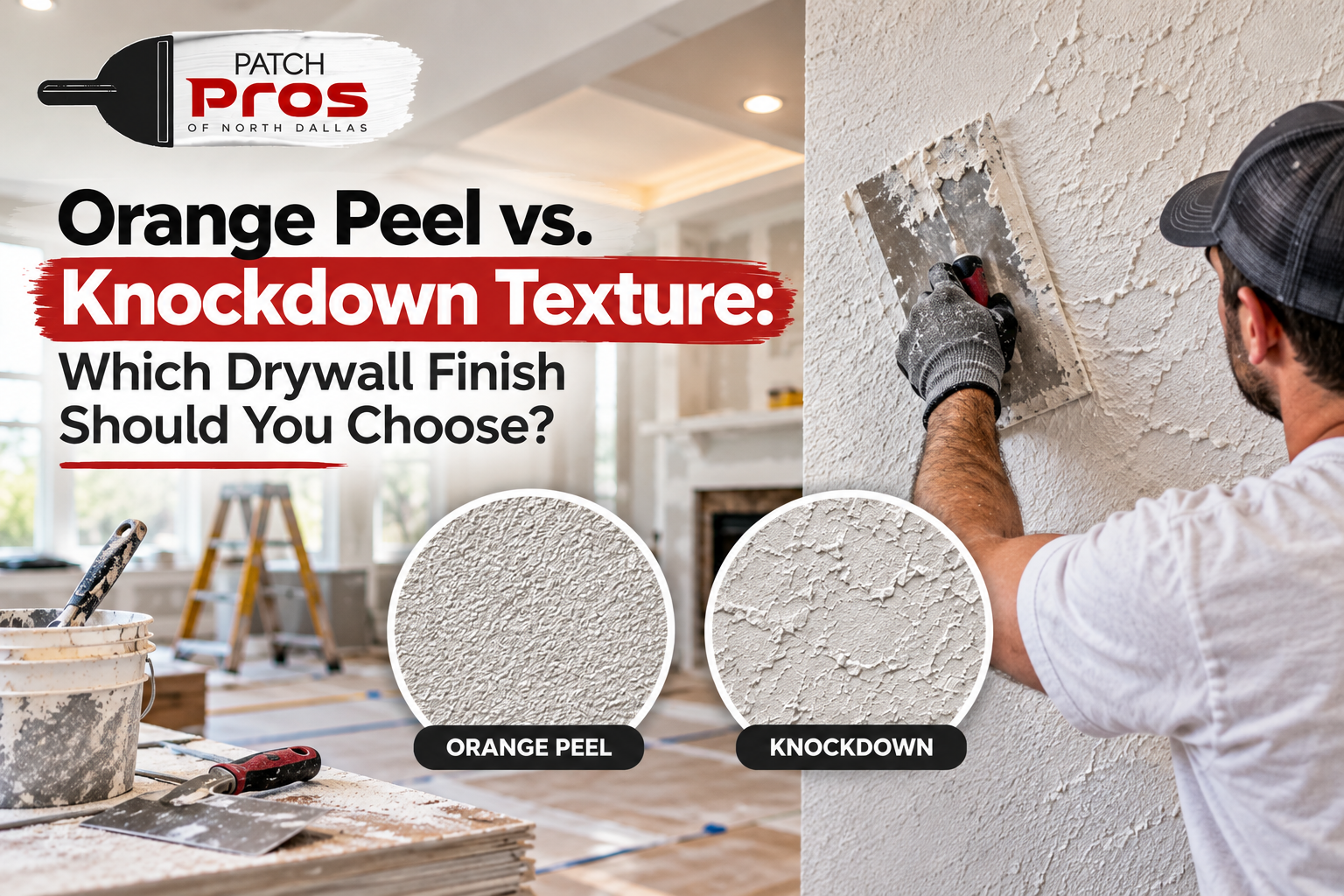
The type of drywall texture selected will impact the overall appearance of a room, whether small imperfections can be easily incorporated into the wall texture, and the level of effort that any future repairs will demand. Orange peel and knockdown texture are two popular choices. Both offer a textured finish for drywall, but in different patterns and ways, and with different looks.
The best option for Dallas homeowners may be dictated by the current wall finishes, interior decor, and budget for renovations. It is important to compare orange peel vs. knockdown texture before starting work to avoid mismatching walls and expensive corrections later in the job.
Orange Peel vs. Knockdown Texture: At a Glance
The biggest difference is the final surface. Orange peel has fine, bumpy marks, whereas knockdown makes the marks wider and flatter to give a more interesting look.
| Feature | Orange peel | Knockdown |
| Appearance | Fine, uniform bumps | Flattened, irregular patterns |
| Application | Sprayed onto the surface | Sprayed, then flattened with a knife |
| Visual effect | Subtle and consistent | More pronounced and decorative |
| Small imperfections | Helps disguise minor flaws | Can conceal some minor surface variations |
| Repairs | Matching the original spray pattern takes practice | Matching flattened marks and spacing can be challenging |
| Cleaning | Generally straightforward | Deeper texture may collect more dust |
There is no right or wrong finish. The ideal drywall texture is the one that matches the room, surface, and texture preference.
Appearance: Subtle Texture or a More Distinctive Finish?
Orange peel drywall texture is more like the skin on an orange. The bumps are small and close together in texture, giving a relatively even pattern without the wall appearing too textured. This is great for bedrooms, hallways, living rooms, and other areas where homeowners desire a consistent wall finish. When painted in a suitable color, the pattern usually remains understated.
Knockdown drywall texture starts with raised splatters of joint compound. Next, a drywall knife is gently moved across the surface, smoothing out the ridges and creating uneven spots.
The outcome is more noticeable than orange peel. It can complement traditional interior design and be used for existing wall and ceiling installations where a stronger texture will help to connect the various wall surfaces. But the final look is very much down to the size of the splatters, consistency of the compound, and when the knockdown step happens.
Application: Which Finish Is Harder to Install?
Both finishes require a properly prepared surface. Dust, uneven joint compound, visible seams, and poorly repaired drywall can affect the final result.
Orange peel generally follows a simpler application sequence:
- Prepare and prime the drywall as needed.
- Mix the texture material to the appropriate consistency.
- Spray the compound using suitable equipment and settings.
- Allow it to dry before applying compatible primer and paint.
The raised texture must be flattened at the proper time, which is an additional important step in knockdown. A wet compound can cause smearing of the pattern. If it becomes too dry, the knife may drag or leave unwanted marks.
A test patch can be used for both finishes to determine the desired pattern before the whole wall is finished. Professional application is particularly beneficial if multiple walls need to be uniform.
Durability, Cleaning, and Everyday Maintenance
The durability of either texture has nothing to do with the pattern. Durability is more dependent on the quality of the preparation of the drywall, compound, paint, and quality of application.
Orange peel is a relatively fine finish that may be easier to wipe. The larger ridges or low areas in the ceiling of knockdown may allow more dust to remain within the area, particularly on ceilings and in areas that are not cleaned often.
Both finishes can be damaged by impacts, furniture, moisture, or aggressive scrubbing. Choose the proper cleaning technique for the paint and don’t keep drywall damp. In cases where there are bubbles in the paint, soft drywall, or recurring stains, treat the moisture problem first, before patching or retexturing. There will be no solution to the cause by covering it with a new texture.
Repair Difficulty: Which Texture Is Easier to Match?
Small repairs can be surprisingly visible when the new texture does not match the surrounding wall. One of the key factors to be taken into account when deciding between these wall texture options is this one.
Applying the correct spray pattern, droplet size, and coverage is critical for orange peel repairs. Excessive compound can result in a heavy patch, and insufficient compound can result in a discernible smooth area.
Knockdown repairs need to be done with the right spray pattern and attention to detail with the knife. The marks should be flattened, and the size, spacing, and depth should be consistent with the other marks.
A useful rule: If you’re deciding on a finish for an entire room, think about the possibility of matching walls at some point in the future. If you have orange peel in most parts of your house, you can continue to use it for repairs in the future as well. The same applies to knockdown.
Cost: What Should Dallas Homeowners Budget?
A drywall finish will cost you more depending on how much surface area you are covering, how much surface work needs to be done, your labor, materials, and whether you need to repair, prime, or paint.
In the Dallas area, texturing a 200-square-foot space is estimated to cost approximately $318.91 to $344.45, or $1.59 to $1.72 per square foot. This is an approximation of the regional price and does not constitute a contractor’s guarantee or a price for either particular texture.
If the compound is to be sprayed, knockdown may need extra labor, as the installer may need to return and flatten the compound at the proper time. However, the actual price difference depends on the project’s conditions. The small repair might also end up running at a higher dollar per square foot since set-up and preparation activities take time, no matter the size of the job.
When comparing estimates, look for whether they involve drywall repairs, masking, texture application, drying time, priming, and painting. It’s better to compare the total price than the price per square foot.
Which Finish Fits Your Home?
Take the time to help you narrow it down with the following guide.
Choose orange peel if you want:
- A subtle, relatively uniform wall pattern.
- A finish that works with many everyday interior styles.
- A texture that is generally straightforward to clean.
- A practical option for matching existing orange peel walls.
Choose knockdown if you prefer:
- A more noticeable, varied texture pattern.
- Flattened marks rather than small, rounded bumps.
- A finish that complements current knockdown walls or ceilings.
- A decorative surface with a more pronounced appearance.
Either type of finish may be used on ceilings, depending on the existing design and desired appearance. Test a sample to see how it looks in the room’s lighting before changing over an entire home from one texture to another. Texture depth can be accentuated by side lighting.
Frequently Asked Questions
Can knockdown texture be applied over orange peel?
Yes, you can, but you’ll need to prep the surface or sometimes even remove the old finish to get a smooth, even look. If you skip this step and apply new texture right on top of a bad surface, you’ll probably end up with patches and inconsistent patterns.
Which texture hides wall imperfections better?
Both knockdown and orange peel can help hide small flaws, but don’t expect miracles; nothing replaces good drywall work. Knockdown can mask some wall inconsistencies since its pattern is bolder, while orange peel looks more uniform but is thinner, so it won’t hide as much.
How long does drywall texture take to dry?
That depends; thicker applications, high humidity, cold temperatures, or poor airflow can slow things down. Let the texture dry all the way before priming or painting. Always check the product label for detailed instructions.
Does texture affect paint compatibility?
You can paint both textures with any standard interior paint. Just make sure the surface is prepped correctly and use a good primer so you get even coverage, especially on fresh or repaired drywall.
Final Thoughts: Choose the Finish That Fits Your Space
Orange peel and knockdown both effectively finish drywall smoothly. They simply appear distinct and follow their own method. Orange peel works when seeking a delicate, uniform texture; knockdown draws more attention because of its clear, flat look.
For Dallas homeowners planning a renovation or repairing damaged walls, Patch Pros of North Dallas can help assess existing textures and determine how to achieve a consistent finish. Selecting the right texture from the start can prevent mismatches, save time, and create a more cohesive finished space.